Share

Pacman Frog
🔤 Taxonomy
Ceratophrys cranwelli is the accepted scientific name for Cranwell’s horned frog, usually sold in the hobby as the Pacman frog.
Common names used in care literature and trade:
- Pacman frog
- Cranwell’s horned frog
- Cranwell’s horned toad
📌 Description
This is a heavy-bodied South American ambush frog with a very large mouth, short limbs, and a strong feeding response. It spends much of the day partly buried with only the head exposed, waiting for prey to come within striking distance.
Adults are display animals, not handling pets. Females are usually larger than males, and long-term welfare depends more on clean moist substrate, stable temperature, safe water, and controlled feeding than on a complicated display.
Plan for a long commitment. A well-kept individual commonly lives 8-15 years, and some animals exceed that range.
📋 Quick reference
| Care point | Practical target |
|---|---|
| Adult size | 10-15 cm, with females usually larger |
| Adult enclosure | At least 60 x 45 x 45 cm for an adult; floor space matters more than height |
| Social housing | Solitary only; cohabitation risks bites and cannibalism |
| Day temperature | 24-28°C ambient, with a warm area around 28-30°C |
| Night temperature | 20-24°C; avoid prolonged chilling and overheating above 30°C |
| Humidity | 60-80%, with brief rises to 75-90% after misting or during shedding |
| Substrate | Moist but not swampy; 8-10+ cm depth for adult burrowing |
| Water | Shallow dechlorinated dish, changed daily or immediately after soiling |
| UVB | Not mandatory, but low-level Ferguson Zone 1 UVB can help when shade is available |
| Diet | Gut-loaded earthworms, roaches, crickets, locusts and occasional other safe feeders |
| Supplements | Calcium on most insect meals for juveniles; adults 1-2 times weekly, plus multivitamin every 2-4 weeks |
| Handling | Display-only; move with wet gloves, wet hands, or a damp container only when necessary |
| Legal status | Not listed by CITES or EU Wildlife Trade Annexes; local rules still apply |
🌍 Distribution
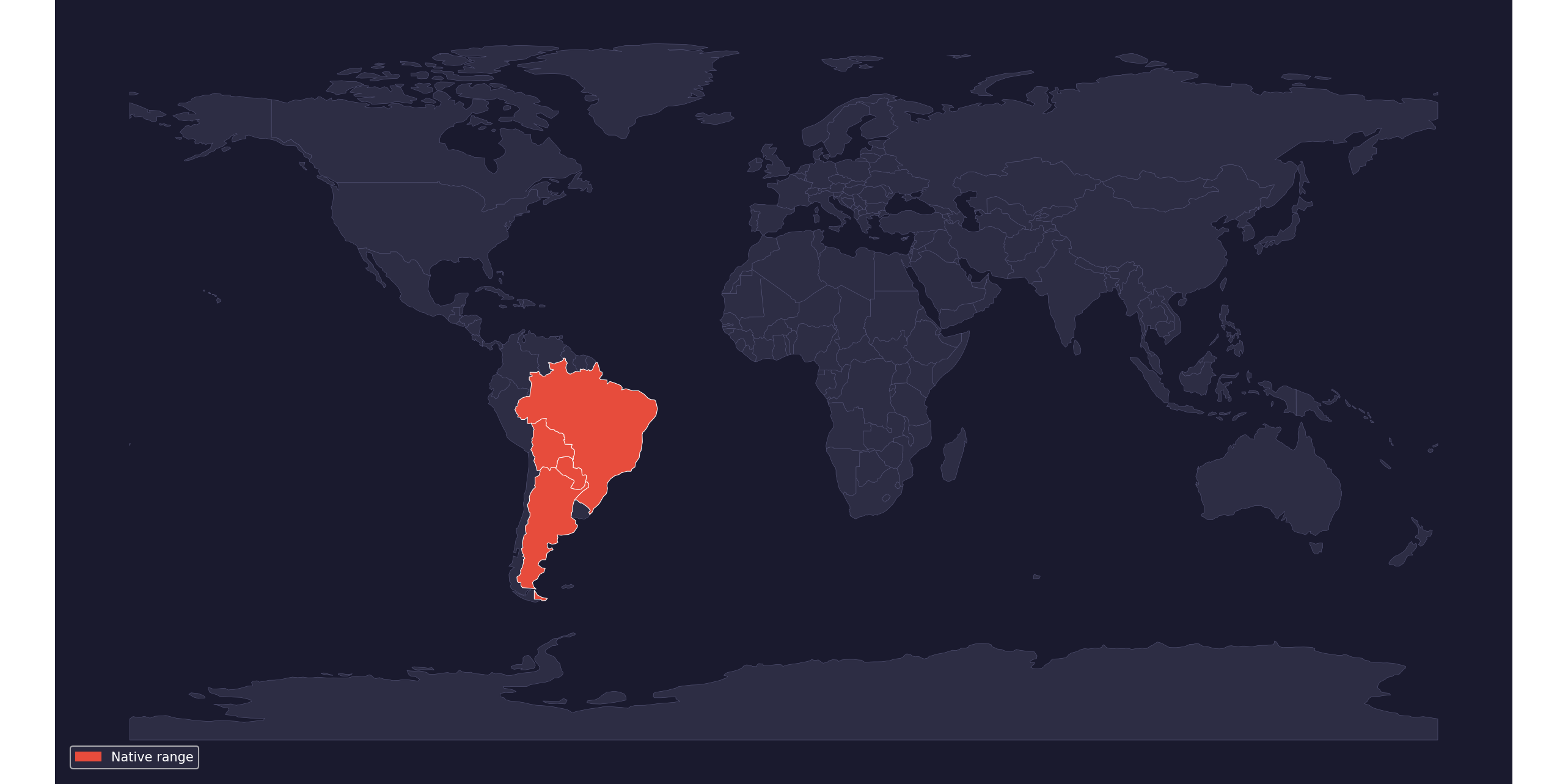
Ceratophrys cranwelli is native to the Gran Chaco region of South America, including parts of Argentina, Paraguay, Bolivia and adjacent Brazil. The useful husbandry lesson is not to keep the frog constantly soaked, but to provide warm seasonal conditions, cover, and a moisture gradient in loose soil and leaf litter.
In captivity this means deep safe substrate, a secure hide, a shallow water dish, and a terrarium that can dry slightly at the surface while remaining moist below.
🌡 Climate across the native range
Monthly climate normals from representative Gran Chaco stations across the native range:
Clorinda, Formosa — Argentina (verified humid Chaco-edge occurrence)
| Month | Min °C | Mean °C | Max °C | RH % |
|---|---|---|---|---|
| January | 24 | 28 | 32.4 | 71 |
| February | 23.5 | 27.2 | 31.5 | 73 |
| March | 22.3 | 26.1 | 30.5 | 73 |
| April | 19.7 | 23.3 | 27.8 | 75 |
| May | 16.3 | 19.6 | 23.7 | 78 |
| June | 14.9 | 18.1 | 22.3 | 78 |
| July | 13.6 | 17.2 | 22 | 75 |
| August | 15.2 | 19.3 | 24.8 | 68 |
| September | 17 | 21.4 | 26.9 | 67 |
| October | 19.8 | 23.9 | 28.9 | 72 |
| November | 20.7 | 24.9 | 29.8 | 71 |
| December | 22.8 | 26.9 | 31.5 | 72 |
Santa Cruz Department — Bolivia (verified northern Chaco occurrence)
| Month | Min °C | Mean °C | Max °C | RH % |
|---|---|---|---|---|
| January | 22.2 | 25.3 | 29.6 | 80 |
| February | 21.9 | 24.8 | 28.9 | 80 |
| March | 21.7 | 24.6 | 28.8 | 79 |
| April | 20.4 | 23.4 | 27.6 | 77 |
| May | 18.2 | 21 | 24.9 | 76 |
| June | 17.3 | 20 | 23.9 | 76 |
| July | 16.6 | 19.7 | 24.2 | 70 |
| August | 18.1 | 21.9 | 27.1 | 62 |
| September | 19.8 | 23.8 | 29.1 | 62 |
| October | 21.4 | 25 | 29.9 | 69 |
| November | 21.6 | 25 | 29.7 | 72 |
| December | 22.1 | 25.1 | 29.4 | 79 |
El Cerrito, Chaco — Argentina (verified southern Gran Chaco occurrence)
| Month | Min °C | Mean °C | Max °C | RH % |
|---|---|---|---|---|
| January | 23.3 | 27.2 | 31.6 | 70 |
| February | 22.7 | 26.4 | 30.6 | 73 |
| March | 21.2 | 24.9 | 29.2 | 75 |
| April | 18.5 | 21.9 | 26.1 | 77 |
| May | 15.2 | 18.3 | 22.2 | 79 |
| June | 13.4 | 16.5 | 20.4 | 80 |
| July | 12 | 15.4 | 20 | 77 |
| August | 13.3 | 17.3 | 22.6 | 72 |
| September | 15 | 19.2 | 24.5 | 71 |
| October | 18.1 | 22.1 | 26.9 | 73 |
| November | 19.5 | 23.8 | 28.6 | 71 |
| December | 22 | 26.2 | 30.7 | 70 |
Weather data by Open-Meteo.com · CC BY 4.0 · Monthly normals calculated by Herpeton Academy from daily archive values.
Location references use GBIF.org occurrence data where available; original occurrence records retain their source dataset licenses.
⚖️ Legal status
This article records Ceratophrys cranwelli as not listed in the CITES Appendices, not listed in EU Wildlife Trade Annexes A-D, and not relevant to the Bern Convention because it is not native to Europe. The legal check was updated on 2026-06-11.
Not listed does not mean unregulated. Import, sale, transport, exhibition, animal-welfare, and local keeping rules may still apply. Keep invoices and breeder or dealer details for every animal.
🤌 Husbandry
House Pacman frogs alone. They are powerful opportunistic predators and can bite another frog, a keeper’s finger, or any moving object that enters feeding range.
The enclosure should be simple enough to keep clean but structured enough for the frog to feel hidden. Provide:
- a warm side and a cooler buried retreat
- at least one snug hide
- leaf litter or plant cover over part of the floor
- a shallow water dish with easy exit
- ventilation that prevents stale wet air without drying the whole setup
Spot-clean waste quickly. These frogs are messy feeders, and fouled substrate can become a skin and bacterial problem before the enclosure looks obviously dirty.
💡 Lighting
Use a clear day-night cycle of about 10-12 hours. Bright exposed terrariums can make the frog stay buried, so visible lighting should be gentle and paired with shaded cover.
Low-level UVB is optional but useful when installed correctly. Treat the species as Ferguson Zone 1 and aim for roughly UVI 0.5-1.0 in the most exposed usable area, with shaded and buried retreats near zero UVI. A low-output T5 or ShadeDweller-style lamp is usually enough in a shallow enclosure; measure with a Solarmeter 6.5 where possible.
Do not use colored night bulbs. If the room falls below target temperatures, use thermostatically controlled heat that does not shine into the enclosure at night.
🌡 Heating and temperature
Stable warmth is safer than intense basking. A practical gradient is 24-28°C across the day, with the warmest safe area around 28-30°C and a cooler retreat around 22-24°C. Night drops to about 20-24°C are acceptable.
Temperatures above 30°C can dehydrate and stress Pacman frogs quickly, especially in small or poorly ventilated tanks. Low temperatures slow digestion and can trigger prolonged refusal to feed.
Use a thermostat on any heat source and check both air and substrate temperatures. Because this species burrows, never use heat rocks and never allow the lower substrate layers to become hotter than the surface.
💧 Humidity and water
Aim for 60-80% relative humidity with a moist lower substrate layer. The surface can dry slightly between mistings; it should not stay sour, swampy, or saturated.
All water that touches the frog must be free of chlorine and chloramine. Change the water dish daily and immediately after the frog soils it. A shallow dish is for soaking, not swimming; the frog must be able to sit and exit without effort.
If the frog has retained skin, correct humidity and provide a clean moist hide first. Short veterinary-guided soaks can help mild retained shed, but repeated shedding problems usually point to humidity, temperature, vitamin status, or skin disease.
🌿 Enclosure, substrate and quarantine
For adults, provide at least 8-10 cm of diggable substrate. A compact but soft mix of organic topsoil, coconut fiber, leaf litter, and a small amount of clay or sand can work well if it holds a burrow without becoming muddy. Avoid pure sand, gravel, bark chunks, and sticky moss feeding surfaces.
Impaction risk is highest when prey is too large, when loose particles stick to feeders, or when juveniles strike directly into coarse substrate. Feed juveniles and messy individuals from a dish, feeding tile, or tongs when safe, and remove loose pieces that can be swallowed.
Quarantine every new frog for 60-90 days in a separate enclosure with separate tools. Use paper towel or another easily monitored substrate during quarantine, track weight and feces, and arrange fecal parasite testing or amphibian disease screening when the animal is wild-caught, imported, thin, or from an unknown source. Do not share misting bottles, cups, tongs, or drainage water between amphibian enclosures.
🪱 Feeding and supplements
Base the diet on varied, gut-loaded invertebrates: earthworms, roaches, crickets and locusts where legal. Use prey no wider than the frog’s head and avoid hard or sharp feeders. Wild-caught insects are not worth the pesticide and parasite risk.
Juveniles may need small meals every 1-2 days. Subadults usually move to every 3-4 days. Adults commonly do well on one moderate meal every 5-7 days, with longer gaps after very large meals. A rounded frog is normal; heavy skin rolls, constant inactivity after meals, and rapid weight gain mean overfeeding.
Supplement schedule:
- juveniles: calcium on most insect meals, with a reptile/amphibian multivitamin about once weekly
- adults with UVB: calcium 1-2 times weekly and multivitamin every 2-4 weeks
- adults without UVB: use a calcium product with D3 periodically, but avoid using high-D3 products at every meal
- earthworms are nutritious but should not be the only food forever; rotate feeders for mineral balance
Rodents should be rare, if used at all. Frequent vertebrate feeding is a common cause of obesity and poor body condition in this species.
🥚 Breeding notes
Breeding is possible but not a beginner project. It usually involves seasonal conditioning, excellent adult body condition, and preparation for very large egg numbers. Clutches can exceed 1,000 eggs, so offspring placement and food production must be solved before pairing animals.
Keep breeding animals unrelated where possible and record parentage, hatch dates, and any locality or line information received with the animals.
🧍 Handling and safety
Handle only when necessary. Amphibian skin absorbs residues easily, so use clean wet hands, powder-free wet nitrile gloves, or a damp container. Avoid soap, lotion, disinfectant residue, dry hands, and rough nets.
The bite is not medically significant, but a large frog can draw blood and may injure itself if pulled away. If it bites, support the frog and wait for it to release rather than yanking.
🩺 Common problems
- Metabolic bone disease: weak bones, tremors, soft jaw or swollen limbs from poor calcium, D3, UVB, or feeder nutrition.
- Impaction: blockage after swallowing oversized prey or unsafe substrate; watch for bloating, straining, no stool, and appetite loss.
- Dysecdysis or retained skin: incomplete shedding, often linked to humidity, dehydration, vitamin imbalance, or skin disease.
- Obesity: a very common husbandry problem caused by frequent large meals, rodents, or feeding every time the frog responds.
- Skin infection or “red leg”: redness, ulcers, foul smell, swelling, or lethargy; treat as urgent.
- Chytridiomycosis and parasites: higher risk in imported or poorly quarantined amphibians; test when history is uncertain.
If appetite drops, first verify temperature, substrate moisture, water quality, recent feeding volume, stool output, and stress. Severe bloating, prolapse, wounds, persistent weakness, abnormal breathing, or continuing refusal to feed needs an amphibian-experienced veterinarian.
✅ Conclusion
The Pacman frog is one of the more approachable display amphibians, but it is not a low-care ornament. Success comes from solitary housing, clean moist substrate, safe water, stable warmth, careful supplementation, and disciplined feeding.
📚 Selected sources
- CITES Appendices, checked 2026-06-11
- European Commission Wildlife Trade Regulations, checked 2026-06-11
- Amphibian Species of the World: Ceratophrys cranwelli
- GBIF Backbone Taxonomy: Ceratophrys cranwelli
- UV Tool and Ferguson zone guidance