Share

Bombina orientalis
🔤 Taxonomy
Bombina orientalis is the currently accepted scientific name and is stable in current hobby use.
English common names used in the hobby:
- Oriental fire-bellied toad
- Fire-bellied toad
German common names used in the hobby:
- Chinesische Rotbauchunke
📌 Description
Bombina orientalis is a small semi-aquatic amphibian recognized by its green-and-black dorsal pattern and vivid orange to red belly. Adults usually reach around 4-6 cm and are active, alert, and often visible by day, which is one reason the species has long been popular in the hobby.
With good care, captive animals commonly live 10-15 years. They are more robust than many delicate tropical frogs, but they are still amphibians with sensitive skin and should not be treated as a handling species. Defensive skin secretions can also irritate human eyes or mucous membranes.
🌍 Distribution
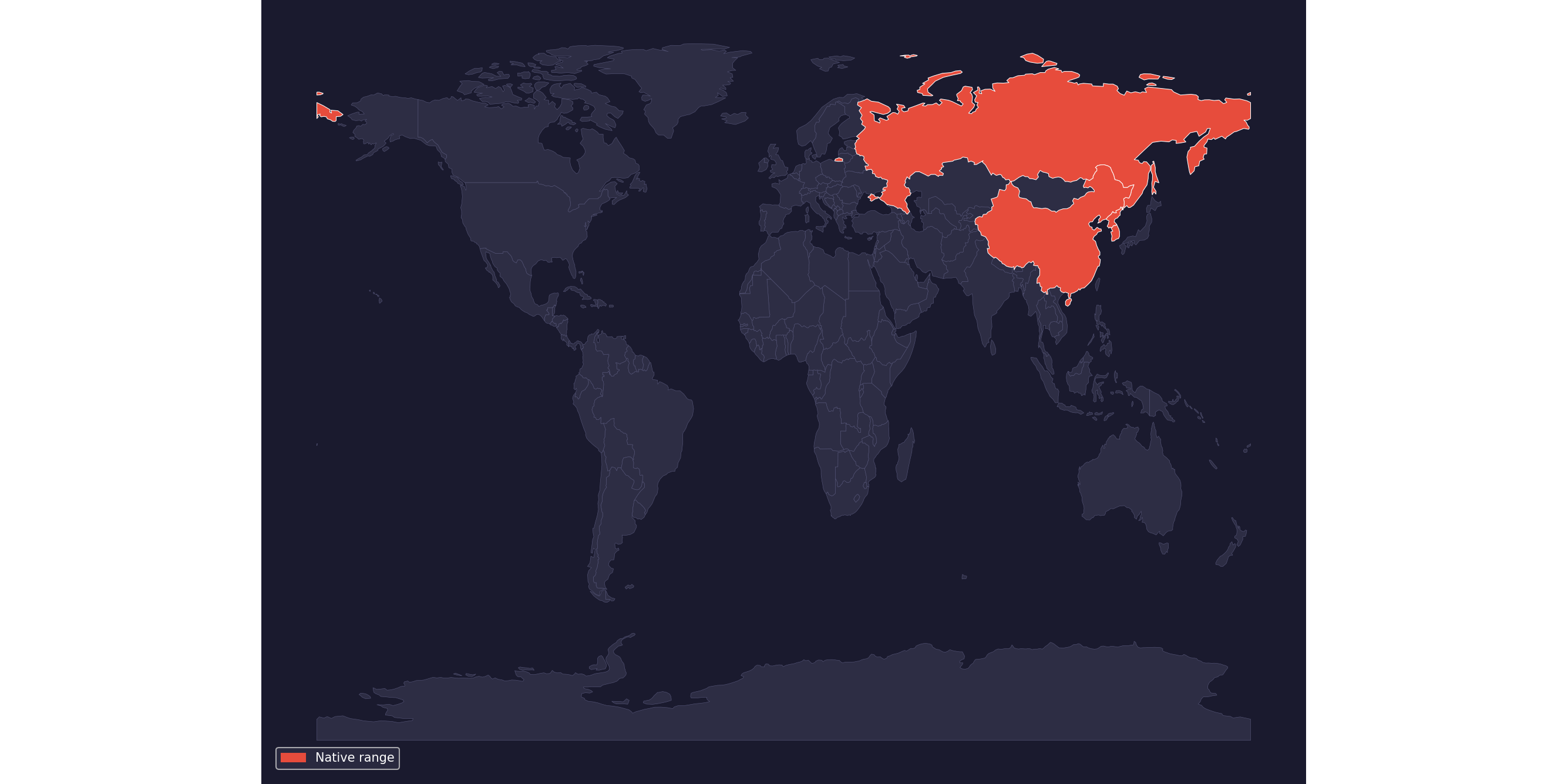
Bombina orientalis is native to northeastern China, the Korean Peninsula and nearby parts of Russia. In the wild it is associated with cool to mild shallow ponds, marsh margins, flooded meadows, ditches and damp low vegetation.
For captive care, the useful lesson from this distribution is:
- stable humidity with fresh airflow rather than stagnant wetness
- leaf litter, roots, plants, or other natural cover at the level the species actually uses
- clean water sources or deposition sites appropriate to the species
- moderate temperatures with night drops where they occur naturally
- a planted enclosure that creates several small microclimates
🌡 Climate across the native range
Monthly climate normals from temperate East Asian stations across the native range:
Seoul — South Korea (Korean Peninsula)
| Month | Min °C | Mean °C | Max °C | RH % |
|---|---|---|---|---|
| January | -7.2 | -3 | 1.5 | 60 |
| February | -4.7 | -0.5 | 4.5 | 61 |
| March | -0.2 | 4.5 | 10 | 66 |
| April | 5.9 | 10.9 | 16.6 | 68 |
| May | 11.9 | 16.6 | 22 | 72 |
| June | 17.4 | 21.5 | 26.3 | 75 |
| July | 21.5 | 24.4 | 27.9 | 84 |
| August | 22 | 24.9 | 28.5 | 83 |
| September | 16.4 | 20.3 | 24.6 | 77 |
| October | 9.1 | 13.6 | 18.5 | 72 |
| November | 1.8 | 5.9 | 10.5 | 71 |
| December | -5 | -1 | 3.3 | 64 |
Liaoning — China (verified northeastern China occurrence)
| Month | Min °C | Mean °C | Max °C | RH % |
|---|---|---|---|---|
| January | -16.9 | -11.4 | -6 | 57 |
| February | -11.5 | -6.1 | -0.6 | 49 |
| March | -3.9 | 1.4 | 7.3 | 47 |
| April | 3.9 | 9.6 | 15.8 | 52 |
| May | 11.3 | 16.8 | 22.7 | 55 |
| June | 17.1 | 21.8 | 26.9 | 66 |
| July | 20.6 | 24.4 | 28.6 | 77 |
| August | 19.5 | 23.3 | 27.5 | 78 |
| September | 13.1 | 17.8 | 23 | 69 |
| October | 4.8 | 9.7 | 15.1 | 63 |
| November | -4.5 | -0.1 | 4.6 | 60 |
| December | -13 | -8.2 | -3.5 | 57 |
Vladivostok, Primorsky Krai — Russia (Russian Far East)
| Month | Min °C | Mean °C | Max °C | RH % |
|---|---|---|---|---|
| January | -12.7 | -9.5 | -6.8 | 63 |
| February | -9.9 | -6.3 | -3.3 | 63 |
| March | -3.3 | -0.5 | 2.1 | 66 |
| April | 2.2 | 4.6 | 7.2 | 75 |
| May | 7.6 | 9.5 | 11.7 | 83 |
| June | 13 | 14.3 | 16 | 89 |
| July | 17.8 | 18.9 | 20.3 | 91 |
| August | 19.7 | 21 | 22.5 | 87 |
| September | 15.8 | 17.8 | 19.6 | 76 |
| October | 8.3 | 10.9 | 13.1 | 68 |
| November | -1.4 | 1.4 | 3.8 | 63 |
| December | -9.9 | -6.8 | -4.3 | 62 |
Weather data by Open-Meteo.com · CC BY 4.0 · Monthly normals calculated by Herpeton Academy from daily archive values.
Location references use GBIF.org occurrence data where available; original occurrence records retain their source dataset licenses.
⚖️ Legal status
As checked against current official sources in April 2026, no current CITES listing was found for Bombina orientalis. No specific EU Wildlife Trade Annex A-D listing was found in the same check.
The species is not relevant to the Bern Convention because it is not native to Europe. Local ownership, collection, transport, import, sale, breeding, and animal-welfare rules may still apply. Captive-bred animals are strongly preferable to undocumented imports.
🤌 Husbandry
Bombina orientalis does best in a cool to mildly warm semi-aquatic setup with clean water, easy haul-out areas, and modest group density. Small groups are often possible when all animals are healthy and similarly sized, but overcrowding should still be avoided.
Useful husbandry priorities include:
- Large shallow water area with safe exits
- Separate resting areas on land
- Clean water with regular maintenance
- Cool to moderate temperatures
- Varied live feeding without overdoing fatty prey
These toads are often active and visible, but that should not lead keepers to assume they tolerate poor hygiene. Dirty shallow water causes problems quickly.
🧪 Filtration and water
Water quality is one of the most important parts of keeping this species well. Because the animals spend much of their time in shallow water and often defecate there, filtration or very frequent water changes are essential.
Key points include:
- Use dechlorinated or otherwise amphibian-safe water
- Keep water shallow enough that the toads can rest easily
- Provide ramps, stones, cork, or sloped land for simple exit
- Clean waste and leftover food promptly
Gentle filtration is often helpful, but strong current is unnecessary. If no filter is used, water changes need to be extremely consistent.
💡 Lighting
A standard day-night cycle of about 10-12 hours works well for most of the year. These toads tolerate brighter enclosures than many secretive amphibians, especially when there is floating cover, moss, cork, or shaded land sections.
Low-level UVB can be beneficial when used gently and when full shade remains available. Night lighting is unnecessary.
For UV planning, treat this species as Ferguson Zone 1. Aim for about UVI 0.5-1.0 in the upper exposed area, while leaving retreats and a gradient down to shaded areas near zero UVI. This usually points to a low-output UVB tube such as a ShadeDweller-style or 2-7% T5, chosen for the enclosure height; measure with a Solarmeter 6.5 when possible, because reflector, mesh, distance, and lamp age change the real exposure.
🌡 Heating and temperature
This species prefers cool to moderate temperatures rather than heat. In many cases, a daytime range of about 20-24°C works well, with somewhat cooler nights. Long exposure to high summer temperatures is a common problem.
Suitable approximate values:
- Daytime ambient: 20-24°C
- Mild upper range: around 25°C
- Night: 16-20°C
Temperatures much above the mid-20s Celsius, especially in poorly oxygenated shallow water, increase stress and disease risk.
💧 Humidity and water
Because this is a semi-aquatic species, water quality and access matter at least as much as ambient humidity. The land section should remain damp enough to support healthy skin, but it should not stay sour and swampy.
Good practice includes:
- Clean shallow water available at all times
- Moist land retreats with moss or similar cover
- Air exchange that prevents stagnant conditions
- Regular checks for spoiled food and fouled substrate
A setup that is wet everywhere but dirty and stale is worse than one with slightly more fluctuation and much better hygiene.
🌿 Enclosure and decoration
A low paludarium or aqua-terrarium usually works better than a tall terrarium. A pair can be kept temporarily in a setup around 45 x 30 x 30 cm, but a small adult group of 3-4 animals should have about 60 x 45 x 30 cm or larger, with broad shallow water and usable land rather than extra height.
Newly metamorphosed juveniles should start in a smaller escape-proof semi-aquatic box around 30 x 30 x 25 cm, with very shallow water, many easy exits, and tiny prey that can be found quickly. Increase water area and total floor space as they grow.
The enclosure should include:
- A stable shallow water area
- Cork, bark, stones, or sloped platforms for haul-out
- Damp terrestrial cover
- Moss, low plants, or floating cover for security
- Open sight lines so animals can thermoregulate and feed easily
Decoration should stay practical and easy to clean. Sharp rocks, deep water, or steep slippery edges are poor choices for this species.
🪱 Feeding
Bombina orientalis is insectivorous and usually feeds readily. A varied diet helps maintain body condition and reduces the temptation to rely on overly rich prey.
Suitable foods include:
- Crickets
- Small roaches
- Earthworm pieces
- Black soldier fly larvae in moderation
- Occasional other suitable invertebrates
Adults often do well on several smaller meals per week. Juveniles may need feeding more often. Calcium should be used regularly, with broader vitamin supplementation added according to the prey range and product schedule.
These toads are prone to overeating if fed too heavily, especially in simple setups with little activity. Body condition should be monitored instead of following appetite alone.
🩺 Common problems
The main recurring problems are overheating, poor water quality, skin irritation, eye trouble, obesity, and bacterial infections linked to dirty shallow water.
Warning signs include:
- Remaining in the water but appearing weak or uncoordinated
- Reddened skin or irritated feet
- Cloudy eyes
- Refusal to feed
- Unusual floating or poor buoyancy
Because skin secretions and stress responses can complicate handling, health checks should stay gentle and brief. Any persistent redness, swelling, skin lesions, or abnormal swimming behavior should be evaluated by an amphibian-experienced veterinarian.
📌 Conclusion
Bombina orientalis is a rewarding and attractive species when kept in a clean cool semi-aquatic enclosure. It is more forgiving than many tropical frogs, but it still depends on excellent water hygiene and sensible temperatures.
For keepers who want an active group-oriented display amphibian with visible daytime behavior, this species remains one of the better choices when its basic needs are respected.
📚 Sources and further reading
- CITES Appendices and Species+ trade database, checked April 2026
- EU wildlife trade regulations and annex references, checked April 2026
- GBIF species backbone and occurrence data for taxonomy and distribution context
- IUCN Red List and specialist husbandry references where applicable
💬 Feedback
For questions, corrections, or practical notes, leave us a message in the forum thread.