Share

Ornate Spiny-tailed Lizard
🔤 Taxonomy
Uromastyx ornata (Heyden, 1827) is the accepted name of the ornate spiny-tailed lizard. Two geographic forms are widely recognized: U. o. ornata around Sinai, southern Israel, and north-western Arabia, and U. o. philbyi along western Saudi Arabia into north-western Yemen. Some references raise philbyi to species level, but molecular work and current GBIF usage retain it within U. ornata.
Older names and combinations that still appear in books and sales lists include:
- Uromastyx ocellatus ornatus
- Uromastyx ornatus
- Uromastyx philbyi
Useful trade names include ornate uromastyx, ornate mastigure, and the German Bunte Dornschwanzagame. A locality or subspecies label should come with breeder records rather than being inferred from colour alone.
📌 Description
This is a 30-37 cm, strongly built desert herbivore with a broad head and a heavily armed tail. Adult males may show intense turquoise, green, yellow, or orange patterning; females and juveniles are usually quieter in colour. Good care can support a lifespan of 15-25 years or more.
The species is not a low-heat “desert lizard.” It needs a body-sized basking surface approaching 50°C, strong UVB, very bright visible light, and nearby cool crevices. Its steep thermal gradient, long commitment, fresh-forage diet, and legal paperwork make it more suitable for an experienced or carefully prepared keeper than an unplanned first reptile.
| Parameter | Practical target |
|---|---|
| Adult size | about 30-37 cm total length |
| Enclosure for one adult | at least 120 x 60 x 60 cm; larger is useful |
| Basking surface | 48-55°C |
| Warm air / cool end | 30-35°C / 24-29°C |
| Night | 18-24°C |
| Humidity | about 20-35%, with a locally more humid deep refuge |
| UVB | strong linear UVB; measured UVI about 4.5-6 at the basking back |
| Diet | varied leaves, weeds, flowers, and a small dry-food component |
🌍 Distribution
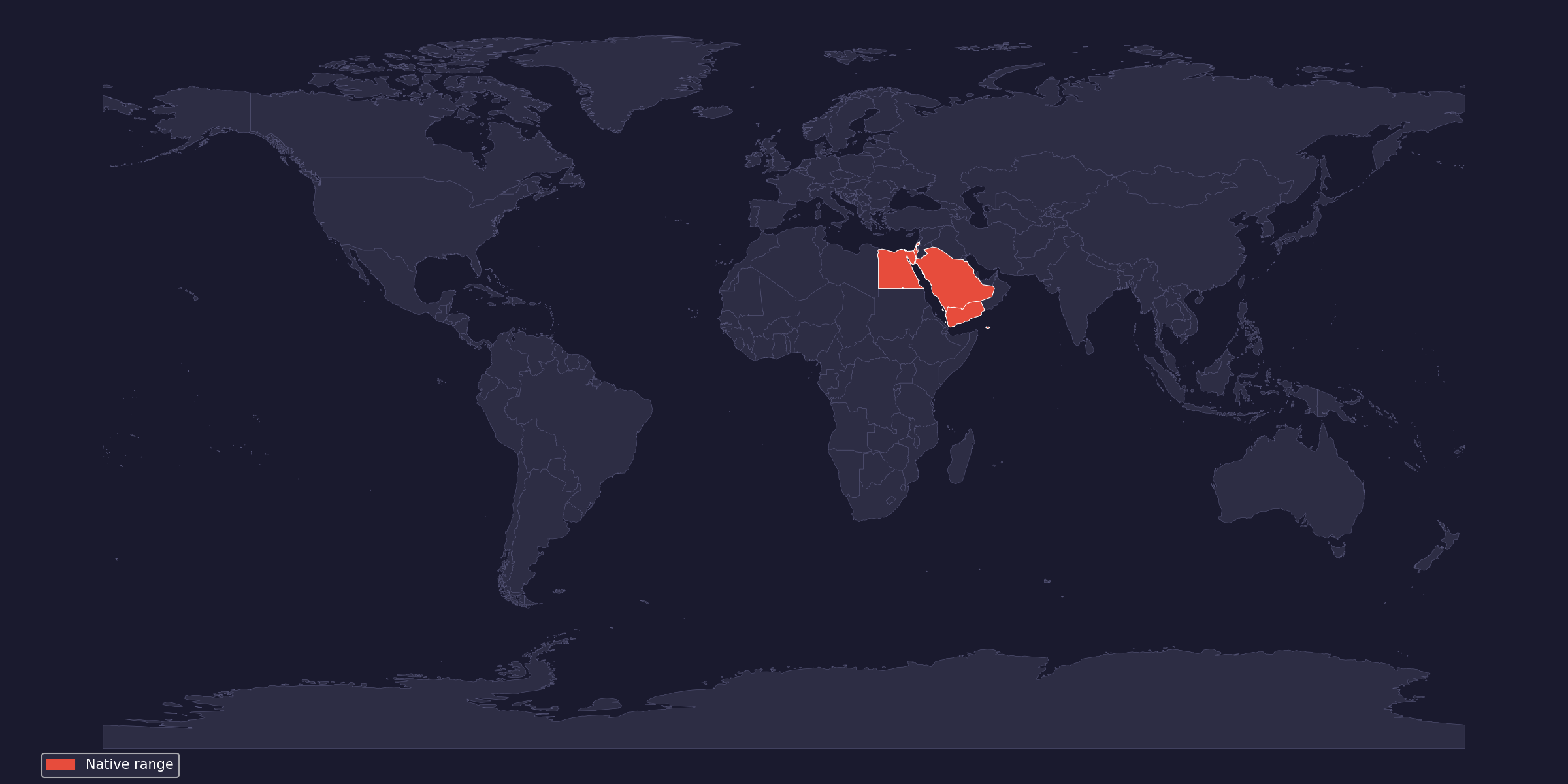
Uromastyx ornata follows arid mountain systems on the eastern side of the Red Sea: Sinai in Egypt, the Eilat area of southern Israel, western Saudi Arabia, and north-western Yemen. Jordan is sometimes mentioned, but published range summaries treat its occurrence there as uncertain, so it is not highlighted on the map.
The species uses rocky wadi slopes, broken mountain faces, and crevices rather than featureless open sand. Wild animals can maintain high body temperatures while moving between exposed feeding sites and deep rock shelters. A vivarium must reproduce that choice of microclimates, not expose the animal continuously to the temperature of open desert air.
🌡 Climate across the native range
Monthly normals from a reviewed GBIF occurrence in the Eilat Mountains, within the northern part of the species’ range:
Eilat Mountains — Israel (reviewed U. ornata occurrence)
| Month | Min °C | Mean °C | Max °C | RH % |
|---|---|---|---|---|
| January | 7 | 11.7 | 16.8 | 59 |
| February | 7.9 | 13.2 | 18.8 | 52 |
| March | 10 | 16.5 | 22.8 | 45 |
| April | 13.5 | 20.9 | 27.8 | 37 |
| May | 17.2 | 25 | 32.1 | 34 |
| June | 19.1 | 27.2 | 34.7 | 36 |
| July | 21.1 | 28.7 | 36.1 | 38 |
| August | 20.9 | 28.5 | 35.9 | 43 |
| September | 18.8 | 26.2 | 33.5 | 49 |
| October | 16.7 | 23 | 29.4 | 52 |
| November | 12.6 | 17.8 | 23.4 | 54 |
| December | 8.5 | 13.2 | 18.5 | 58 |
Weather data by Open-Meteo.com · CC BY 4.0 · Monthly normals calculated by Herpeton Academy from daily archive values.
Location references use GBIF.org occurrence data where available; original occurrence records retain their source dataset licenses.
⚖️ Legal status
Checked on 2026-08-30: Uromastyx ornata is covered by the genus-level listing of Uromastyx spp. in CITES Appendix II and EU Annex B. International movement and import therefore require the relevant CITES and customs documents; within the EU, reliable proof of lawful acquisition remains important for sale and transfer. It was not found in the current Bern Convention appendices and is not a European native species.
Trade status does not replace national law. Before buying, breeding, selling, or transporting an animal, check the rules in both countries involved. Keep the dated invoice, scientific name and locality supplied by the breeder, breeder or importer details, transfer history, permit numbers where applicable, and clear identification photographs. Avoid undocumented or vaguely labelled imports.
🤌 Husbandry
Use at least 120 x 60 x 60 cm for one adult, with 150 cm or more of length preferred when space permits. House singly. Males are territorial, and either sex may chase, bite, tail-whip, block a retreat, or monopolize heat. Even a pair that appears calm can maintain chronic social pressure that is difficult to see.
Prepare and measure the complete enclosure before acquisition. Quarantine a new animal for 60-90 days away from other reptiles, with separate tools, paper or another easily monitored floor, and tight washable hides. Record weight, food intake, feces, urates, shedding, and activity. Wild-sourced, thin, or symptomatic animals need an examination by a reptile-experienced veterinarian and fecal testing when indicated; preventive medication without a diagnosis can cause harm.
Approach slowly and support the entire body if lifting is necessary. Do not pull an animal from a crevice or restrain it by the tail. Short voluntary interaction is safer than routine handling, and a newly arrived animal should first establish normal basking and feeding.
💡 Lighting
Install a high-output linear T5 UVB lamp over the warm half and a bright daylight source across most of the enclosure. At the animal’s back on the main basking ledge, a measured UVI around 4.5-6 is a practical target, with lower ledges, partial shade, and dark cracks within easy reach. Mesh, reflector, lamp age, and distance all alter the dose; use a UV meter where possible and follow safe-distance guidance.
Run roughly 12 hours of light in the active season. A gradual reduction toward 10 hours is appropriate only as part of a planned winter cycle. White light belongs to daytime; red, blue, or “moonlight” lamps should not be used at night. Replace UVB lamps according to measured decline or the manufacturer’s tested interval.
🌡 Heating and temperature
Create a wide stone or slate basking surface at 48-55°C, large enough to warm the whole animal evenly. Warm-side air may reach 30-35°C while the cool end remains 24-29°C. Allow a night fall to 18-24°C. Multiple halogen floods usually make a safer body-sized heat patch than one concentrated high-wattage bulb.
Measure basking surfaces with an infrared thermometer and air and hide temperatures with separate digital probes. Secure and guard every heat source that the animal could reach. Heat rocks, unregulated mats, and unstable sun-heated glass can burn the belly while giving a misleading air reading.
A winter slowdown is optional and mainly useful for established breeding adults. Healthy adults may receive shorter days and a gradual night reduction toward about 14-18°C for several weeks while daytime basking remains available and feeding is reduced appropriately. Do not cool a juvenile, underweight, ill, dehydrated, newly acquired, or untreated parasite-positive animal.
💧 Humidity and water
Keep the ventilated surface dry and general relative humidity near 20-35%. A lower layer beneath a secure retreat may remain slightly moist, creating a protected humidity gradient for hydration and shedding. Do not achieve this by wetting the entire enclosure: cool damp air and stale substrate encourage respiratory and skin disease.
Provide a small, stable bowl of fresh water. Many animals drink rarely and obtain much of their water from fresh greens, but withholding water removes an important choice. Replace it when soiled. Routine soaking is unnecessary and stressful; hydration problems require correction of diet, environment, and veterinary assessment rather than forced bathing.
🌿 Enclosure and decoration
After quarantine, provide 15-20 cm of compactable sandy soil. A useful starting mix is about 50% washed fine sand, 30% pesticide-free topsoil, and 20% clay. Pack it firmly, keep the upper layer dry, and moisten only a selected deep area. Rest every heavy rock and slab on the solid enclosure base before adding substrate so digging cannot cause a collapse.
Build several body-tight crevices at different temperatures, broad rough basking ledges, low climbing routes, and visual barriers. U. ornata makes active use of broken rocky structure and should not be kept in a bare sand box. Avoid calcium sand, crushed walnut, dusty powder, wood chips, loose gravel, adhesive surfaces, and exposed foam.
Offer food on a clean dish or flat rock. Loose substrate becomes more dangerous when the lizard is dehydrated, too cool to digest, ill, or swallowing substrate-coated food; these conditions, rather than normal digging alone, are central impaction risks.
🥬 Feeding
Feed juveniles daily and established adults four to six days per week, adjusting quantity to growth and body condition. Most of the diet should be varied, calcium-rich leaves, weeds, and flowers: dandelion, plantain, sow thistle, endive, escarole, chicory, mustard and turnip greens, mulberry leaves, hibiscus leaves and flowers, safe clover, and unsprayed rose petals. Rotate species and wash cultivated produce.
Use finely chopped squash, green beans, grated carrot, soaked high-quality herbivore pellets, lentils, and small seeds as minor variety rather than the base of every meal. Fruit should be rare and small. Do not routinely feed insects, eggs, meat, dog or cat food, or other high-protein animal products; these encourage obesity and place an unnecessary metabolic load on a specialist herbivore.
Lightly dust fresh food with plain calcium once or twice weekly. Use a reptile multivitamin according to its label and the actual UVB arrangement; calcium with D3 should not be layered automatically on top of strong measured UVB and fortified food. Do not combine several vitamin products. Monitor the jaw, limbs, body mass, and female condition rather than increasing supplements by guesswork.
🥚 Breeding notes
Sexual colour differences become clearer with maturity, but locality and individual variation make colour alone unreliable in young animals. Breeding should involve healthy, mature, accurately sexed adults with documented origin and separate permanent enclosures. Introductions require continuous observation because courtship can become aggressive.
Provide a private nesting zone at least 20 cm deep with slightly moist, diggable soil. Wild observations report clutches of 7-17 eggs, and captive incubation is commonly conducted around 30-32°C for roughly 70-90 days. Duration changes with temperature and method; do not rotate freshly recovered eggs. A gravid female that repeatedly digs, strains, becomes weak, or fails to lay needs urgent veterinary assessment for dystocia rather than repeated handling.
🩺 Common problems
Frequent preventable problems include metabolic bone disease from inadequate UVB or calcium imbalance, thermal burns, dehydration, retained shed around toes and tail, respiratory disease in cold damp housing, obesity and gout risk from excessive protein, intestinal parasites in imports, and substrate or food impaction when heat and hydration are poor.
Seek a reptile-experienced veterinarian for sustained weight loss, sunken eyes, a soft or misshapen jaw, swollen limbs, tremors, weakness, unusual hiding, abnormal breathing, nasal discharge, repeated diarrhea, constipation with declining condition, skin lesions, or reproductive straining. First check measured temperatures, UVB, diet, and water access, but do not substitute enclosure changes for diagnosis.
📌 Conclusion
The ornate spiny-tailed lizard suits a keeper who can provide a genuinely hot body-sized basking area, strong measured UVB, stable rock-like retreats, and varied fresh forage for decades. Have the enclosure, food supply, quarantine space, and origin documents ready before choosing the most colourful animal.
📚 Sources and further reading
- ReptiFiles: Uromastyx care sheet
- Khannoon 2012: mitochondrial variability within U. o. philbyi
- CITES CoP15 Proposal 10: biology, range, and trade review for U. ornata
- The Reptile Database: Uromastyx ornata
- GBIF Backbone Taxonomy: Uromastyx ornata
- Baines et al. 2016: UVB provision for captive reptiles
- CITES species record: Uromastyx ornata, checked 2026-08-30
- Commission Regulation (EU) 2026/1383, checked 2026-08-30
- Bern Convention appendices, checked 2026-08-30