Share

Macfadyen's Mastigure
🔤 Taxonomy
Uromastyx macfadyeni is the accepted scientific name for Macfadyen’s mastigure. Older literature and trade labels may show Uromastix macfadyeni or Uromastyx ocellata macfadyeni.
Common names include Macfadyen’s mastigure, Somali spiny-tailed lizard, and Somali mastigure. German trade material may use Macfadyens Dornschwanzagame.
📌 Description
This is one of the smaller spiny-tailed lizards, usually about 22-28 cm including the tail. It is a dry-country, sun-loving herbivore with the same core risks as other Uromastyx: weak UVB, insufficient basking heat, damp cool housing, poor plant variety, and undocumented origin.
Buy captive-bred animals with clear paperwork whenever possible. Imports can be thin or dehydrated and should be treated as higher-risk until quarantine, feeding records, and fecal checks say otherwise.
🌍 Distribution
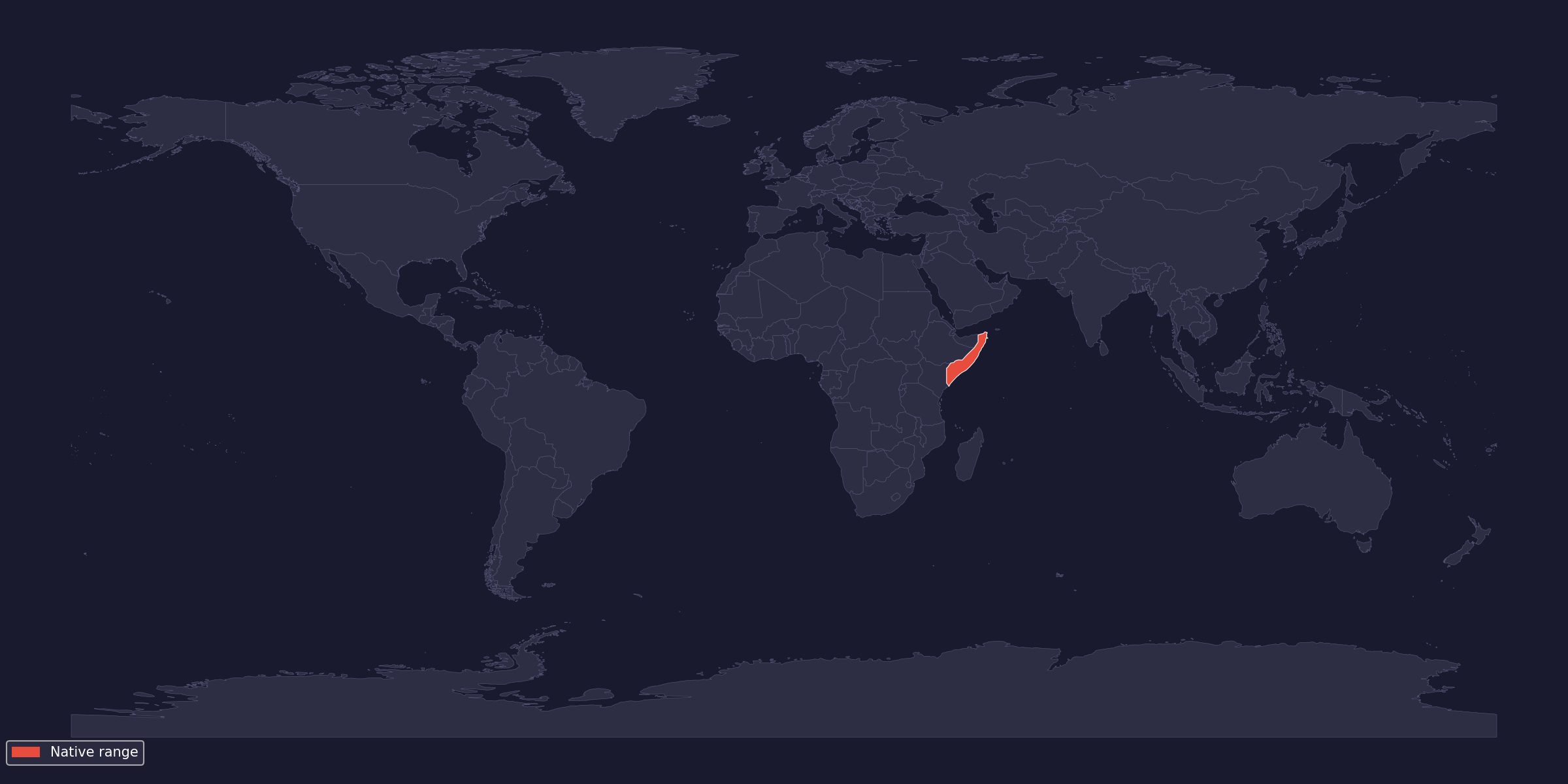
Uromastyx macfadyeni is endemic to northwestern Somalia, especially the Somaliland region around Berbera and West Galbeed. It is associated with hot stony shrubland, rocky flats, and low arid areas where it shelters beneath stones and in crevices.
⚖️ Legal status
Checked on 2026-09-02: Uromastyx macfadyeni is covered by the genus-level Uromastyx spp. listing in CITES Appendix II and by EU Annex B under the current EU wildlife trade annexes. International trade requires valid CITES export, import, or re-export documents as applicable. In the EU, Annex B commercial transfers require reliable proof of lawful acquisition.
The Bern Convention is not relevant because the species is not native to Europe. Local and national rules may still apply. Keep the invoice, scientific name, breeder or importer details, CITES permit or certificate numbers where relevant, transfer records, and identification photos for the life of the animal. Avoid animals sold only under a vague “uromastyx” label or without legal-origin paperwork.
🤌 Husbandry
Provide one adult with at least 120 x 60 x 60 cm. More length helps create the intense basking zone and a usable cool retreat. House singly unless breeding is being managed by an experienced keeper with spare enclosures ready.
Quarantine for 60-90 days in a separate room where possible. Use paper or another monitorable surface first, keep separate tools, and record weight, feeding, feces, urates, shed, and basking behavior. Ask a reptile veterinarian about fecal testing for wild-origin, thin, or symptomatic animals.
| Parameter | Practical target |
|---|---|
| Adult enclosure | at least 120 x 60 x 60 cm |
| Basking surface | 45-55°C |
| Warm air / cool end | 28-35°C / 24-29°C |
| Night | 18-23°C |
| Ambient humidity | 30-45%, with a locally more humid refuge |
| UVB | strong linear UVB; measured UVI about 4.5-6 at the basking back |
| Diet | varied leafy weeds, greens, flowers, and limited seeds or soaked pellets |
💡 Lighting
Use a high-output linear T5 UVB lamp over the warm half plus bright visible daylight. Aim for a measured UVI around 4.5-6 at the basking back, with lower ledges and dark retreats available.
Run about 12 hours of light in the active season and reduce gradually toward 10 hours only for a planned winter cycle. Replace UVB lamps on schedule and measure output where possible.
🌡 Heating and temperature
Create a broad stone or slate basking platform at 45-55°C. Warm air can sit around 28-35°C, while the cool end should remain 24-29°C. Nights can fall to 18-23°C. Use overhead halogen floods that warm the animal’s whole body.
Anchor all heavy rocks before adding substrate. Measure surfaces with an infrared thermometer and air zones with digital probes. A winter reduction to roughly 15-18°C at night is only for stable healthy adults.
💧 Humidity and water
This coastal-arid species tolerates slightly more humidity than many inland Uromastyx, but it still needs dry ventilation. Keep ambient humidity around 30-45%, with a locally more humid deep refuge for hydration and shedding.
Provide a small clean water bowl. Occasional light night misting can help some animals drink, but the surface should dry quickly. Avoid cool damp air and wet substrate.
🌿 Enclosure and decoration
After quarantine, use 15-20 cm of compactable sandy soil or sand/soil/clay mix. Keep the upper layer dry and add moisture only to a chosen deeper refuge.
Include tight rock-like hides, stable crevices, broad basking stones, low climbing routes, and visual barriers. Avoid calcium sand, crushed walnut, dusty substrate, loose gravel, resinous wood, and unstable rock piles.
🥬 Feeding
Feed juveniles daily and established adults most days, adjusting portions to body condition. The core diet should be high-calcium plant matter: dandelion, plantain, sow thistle, endive, escarole, chicory, mustard and turnip greens, mulberry leaves, hibiscus, safe weeds, and pesticide-free flowers.
Use squash, green beans, grated carrot, soaked quality herbivore pellets, and small amounts of safe seeds or lentils only as variety. Fruit should be rare. Routine insects, eggs, rodents, dog food, cat food, and other animal protein are inappropriate.
Dust food lightly with plain calcium once or twice weekly and use a reptile multivitamin according to measured UVB and the product label. Do not stack several fortified products.
🥚 Breeding notes
Breeding should be attempted only with mature, well-conditioned animals of documented legal origin. Females need a private laying box or deep zone with 15-20 cm of damp diggable substrate. Published incubation values for related small Uromastyx vary, so plan conservatively around 29-31°C and roughly 70-100 days.
🩺 Common problems
Common problems include metabolic bone disease from weak UVB or calcium imbalance, burns from concentrated heat, respiratory disease in cool damp housing, dehydration, retained shed around toes or tail, obesity, intestinal parasites in imports, and impaction when heat, hydration, substrate, or feeding practice is wrong.
Seek a reptile-experienced veterinarian for weight loss, a sunken abdomen, swollen joints, soft jaw, tremors, abnormal breathing, nasal discharge, persistent diarrhea, severe constipation, or straining by a gravid female.
📌 Conclusion
Uromastyx macfadyeni suits a keeper who can provide hot desert lighting, a dry but not desiccating enclosure, fresh forage, quarantine discipline, and legal-origin paperwork. The animal should be treated as a display-first lizard, not a casual handling pet.
📚 Sources and further reading
- ReptiFiles: Uromastyx care sheet
- Arids Only: Uromastyx care guide
- The Reptile Database: Uromastyx macfadyeni
- GBIF Backbone Taxonomy: Uromastyx macfadyeni
- CITES Appendices, checked 2026-09-02
- EU Wildlife Trade Legislation / Species+, checked 2026-09-02
- Commission Regulation (EU) 2026/1383, checked 2026-09-02
- Bern Convention appendices, checked 2026-09-02
- Baines et al. 2016: UV-Tool