Share

Saharan Spiny-tailed Lizard
🔤 Taxonomy
Uromastyx geyri is the accepted name for this small Saharan spiny-tailed lizard. Older books and sales lists may place it within Uromastyx acanthinura as U. acanthinura geyri; modern references treat it as a full species.
Common trade names include Saharan uromastyx, Geyr’s spiny-tailed lizard, Sahara mastigure, and the German Geyrs Dornschwanzagame. Colour labels such as “red” and “yellow” describe appearance, not separate taxa.
📌 Description
This is a compact but demanding desert herbivore. Adults normally reach 25-36 cm including the thick spiny tail and often weigh roughly 180-300 g. A well-kept animal may live 15-25 years, so the heat, lighting, and food supply are long-term commitments.
The species is active in full daylight and retreats into rock cracks and burrows. Its captive enclosure must therefore combine exceptionally hot exposed basking surfaces with cooler, tight shelters. A lukewarm tank with a single decorative hide does not let it digest, regulate UV exposure, or feel secure.
Captive-bred animals with documented origin are strongly preferred. Recently imported animals can arrive dehydrated, thin, and heavily parasitized even when their bright colour hides poor body condition.
🌍 Distribution
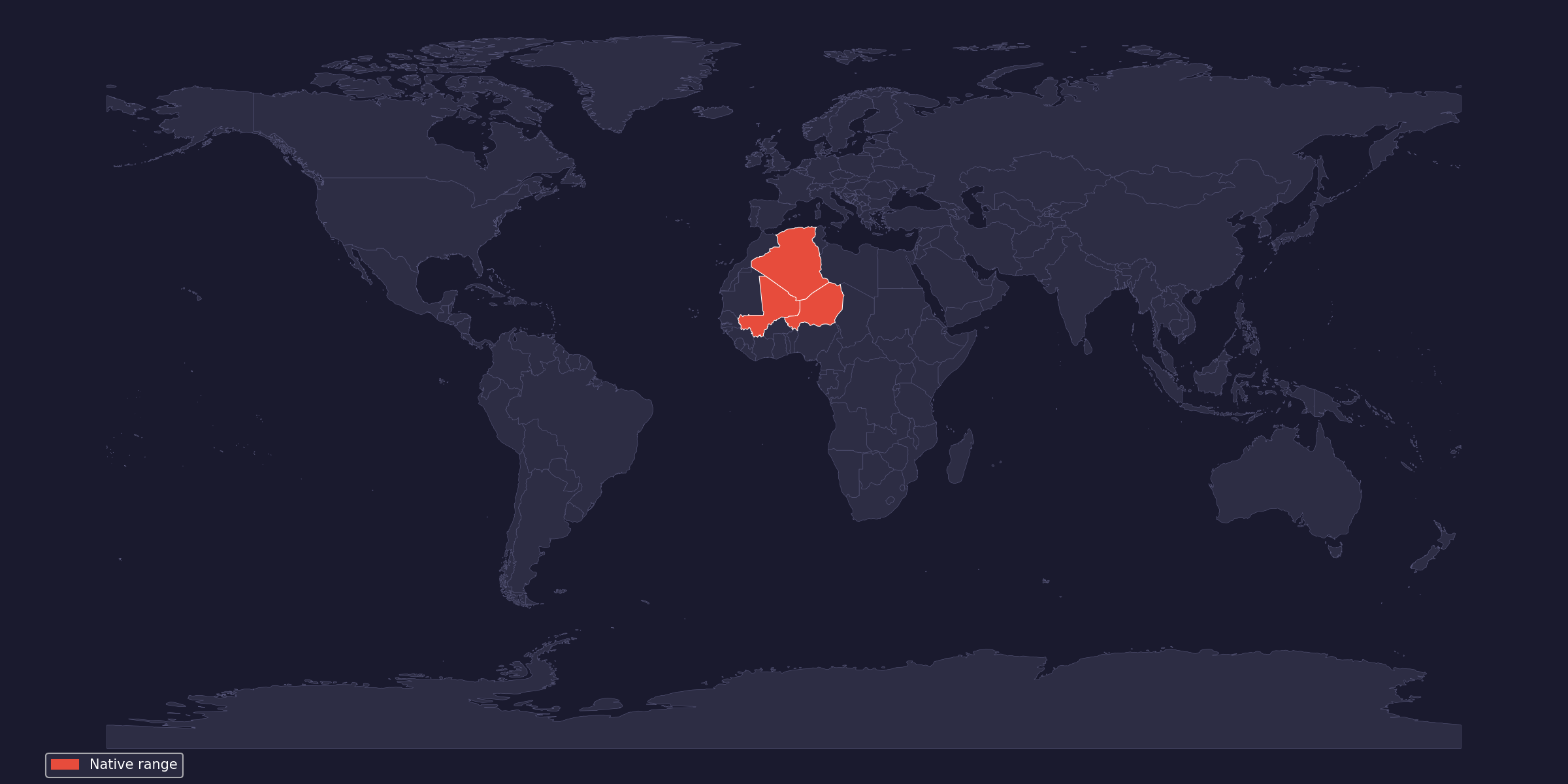
Uromastyx geyri occurs in the central Sahara of southern Algeria, northern Mali, and Niger, especially around the Ahaggar/Hoggar and Aïr mountain systems. It uses rocky outcrops, stony wadis, and arid slopes where crevices provide shelter from extreme surface heat and cold nights.
The range is intensely bright and dry, but a refuge is not identical to the open air above it. Captive care should provide dry ventilation and sun-like heat while preserving slightly cooler, more humid conditions deep inside stable hides.
⚖️ Legal status
Checked on 2026-08-20: all Uromastyx species are listed in CITES Appendix II and EU Annex B. Trade across borders therefore requires the applicable CITES permits, and EU commercial transfers require reliable proof of lawful acquisition. The EU also suspends introduction of wild-sourced U. geyri from Mali and Niger under Implementing Regulation (EU) 2025/6.
The Bern Convention is not relevant because the species is not native to Europe. National registration, document, import, sale, and transport rules can still be stricter. Keep the invoice, scientific name, breeder and parent-stock details, transfer record, permit numbers where applicable, and identification photographs for the life of the animal. Do not buy an animal whose seller cannot explain its legal origin.
🤌 Husbandry
Provide one adult with at least 120 x 60 x 60 cm; 150 cm or more of length is valuable for a wider heat gradient and exercise. House singly. Courtship and dominance can involve chasing, blocking basking sites, tail strikes, and bites, while apparently peaceful animals may simply be suppressing one another.
Quarantine a new arrival for 60-90 days in a separate room where possible, using paper or another easy-to-monitor surface, its own tools, and several secure hides. Record weight, food intake, feces, urates, and activity. A reptile veterinarian should assess thin, wild-sourced, or symptomatic animals and decide whether fecal testing is appropriate; do not administer dewormers by guesswork.
| Parameter | Practical target |
|---|---|
| Adult enclosure | at least 120 x 60 x 60 cm |
| Basking surface | 45-55°C |
| Warm air / cool end | 28-35°C / 25-29°C |
| Night | 18-22°C |
| Ambient humidity | about 20-40%, with a locally more humid deep refuge |
| UVB | strong linear UVB; measured UVI about 4.5-6 at the basking back |
| Diet | varied leafy weeds, greens, and flowers; little fruit and no routine animal protein |
💡 Lighting
Use a bright full-length daylight source and a high-output linear T5 UVB lamp over the warm half. At the main basking position, target a measured UVI around 4.5-6, with lower ledges and dark cracks available within a few steps. Mesh, reflector, distance, and lamp age can change output dramatically, so a UV meter is preferable to selecting a bulb by percentage alone.
Run a 12-hour day for most of the active season, reducing gradually toward 10 hours only for a planned winter cycle. Strong visible light is part of the husbandry, not decoration: dim enclosures commonly produce inactivity even when the thermometer appears correct.
🌡 Heating and temperature
Create a broad basking platform with a surface temperature of 45-55°C. Warm air may range from 28-35°C, while the cool end should remain around 25-29°C. Allow nights to fall to 18-22°C. Use multiple halogen floods for an even body-sized patch rather than one dangerously concentrated spot.
Flat stone stacks separated by secure gaps can create a useful series of warm retreats. Anchor every heavy element before adding substrate. Control the heat system appropriately, guard accessible lamps, and check both surfaces and air with an infrared thermometer and independent digital probes.
A winter reduction is optional and mainly useful for established breeding adults. Healthy animals can receive a gradual night drop to about 14-16°C with shorter days and reduced food for one to two months while daytime basking remains available. Never cool a juvenile, thin, ill, newly arrived, or poorly hydrated animal.
💧 Humidity and water
Keep general humidity low, normally 20-40%, and let the surface dry fully. Maintain a slightly moist lower layer or protected burrow rather than spraying the whole enclosure. Damp, cool air promotes respiratory and skin disease; bone-dry hides with no drinking opportunity can still cause dehydration and poor sheds.
Provide a small clean water bowl even though much water comes from fresh leaves. Juveniles may also drink droplets placed on a rock. The bowl should not be large enough to raise humidity substantially, and water must be replaced whenever soiled.
🌿 Enclosure and decoration
After quarantine, use 15-20 cm of compactable sandy soil: roughly 50% washed fine sand, 30% pesticide-free topsoil, and 20% clay is a workable starting mix. Pack it firmly enough to support shallow excavations. Keep the top dry, add moisture only to a selected deep area, and prevent any stone stack from resting on loose substrate.
Include several body-tight cracks, broad stone or slate basking surfaces, low climbing routes, and visual barriers. Avoid calcium sand, crushed walnut, wood chips, dusty material, and loose gravel. Impaction risk rises when food is placed directly on substrate, the lizard is dehydrated, or basking temperatures are inadequate; offer salads on a clean dish or rock.
🥬 Feeding
Feed juveniles daily and established adults five or six days per week, adjusting portions to body condition. The core diet should be diverse high-calcium leaves and flowers: dandelion, plantain, sow thistle, endive, escarole, chicory, mustard and turnip greens, mulberry leaves, hibiscus leaves and flowers, and pesticide-free clover. Rotate foods rather than building every meal around one supermarket leaf.
Use squash, green beans, grated carrot, soaked quality herbivore pellets, and small quantities of safe pulses or seeds only as minor variety. Fruit is an occasional small treat at most. Routine insects, eggs, rodents, dog food, and other high-protein animal foods are inappropriate and can promote obesity and organ disease.
Lightly dust food with plain calcium once or twice weekly and use a reptile multivitamin according to its label and the measured UVB plan. Do not combine several fortified products. Fresh plant foods should supply hydration; dry seed bowls must not replace leafy forage.
🥚 Breeding notes
Females need a private laying box or deep zone with about 15-20 cm of damp, diggable substrate. A published zoo account recorded 11 eggs and incubated fertile eggs at 30.5°C; hatchlings emerged on days 91-96. Other clutches can be larger. Because incubation moisture and temperature errors can destroy an entire clutch, breeding is not a casual extension of pet care.
Monitor females closely after laying, when they may appear markedly depleted, and temporarily increase access to nutritious greens and calcium. Do not cycle or breed an underweight animal, and have space and strong lighting ready for every hatchling before pairing adults.
🩺 Common problems
Preventable problems include metabolic bone disease from weak UVB or calcium imbalance, burns from concentrated or unguarded heat, respiratory disease in cool damp housing, dehydration, retained shed around toes or tail, obesity, and intestinal parasites in imports. Poor heat can also reduce digestion and contribute to food or substrate impaction.
Seek a reptile-experienced veterinarian for sustained weight loss, a sunken abdomen, swollen joints, soft jaw, tremors, inability to bask normally, abnormal breathing, nasal discharge, repeated diarrhea, severe constipation, or straining by a gravid female. Correcting the enclosure is essential, but it is not a substitute for diagnosis.
📌 Conclusion
Uromastyx geyri suits a keeper who can deliver very bright light, a 45-55°C basking surface, deep stable refuges, and fresh varied forage every week of the year. Legal provenance and quarantine matter as much as colour; a cheap undocumented import is a poor starting point for a long-lived desert lizard.
📚 Sources and further reading
- ReptiFiles: Uromastyx care sheet
- Radovanovic 2020: Husbandry and reproduction of Uromastyx geyri
- The Reptile Database: Uromastyx geyri
- GBIF Backbone Taxonomy: Uromastyx geyri
- Baines et al. 2016: UVB provision for captive reptiles
- CITES Appendices, checked 2026-08-20
- Commission Regulation (EU) 2026/1383, checked 2026-08-20
- Commission Implementing Regulation (EU) 2025/6, checked 2026-08-20