Share

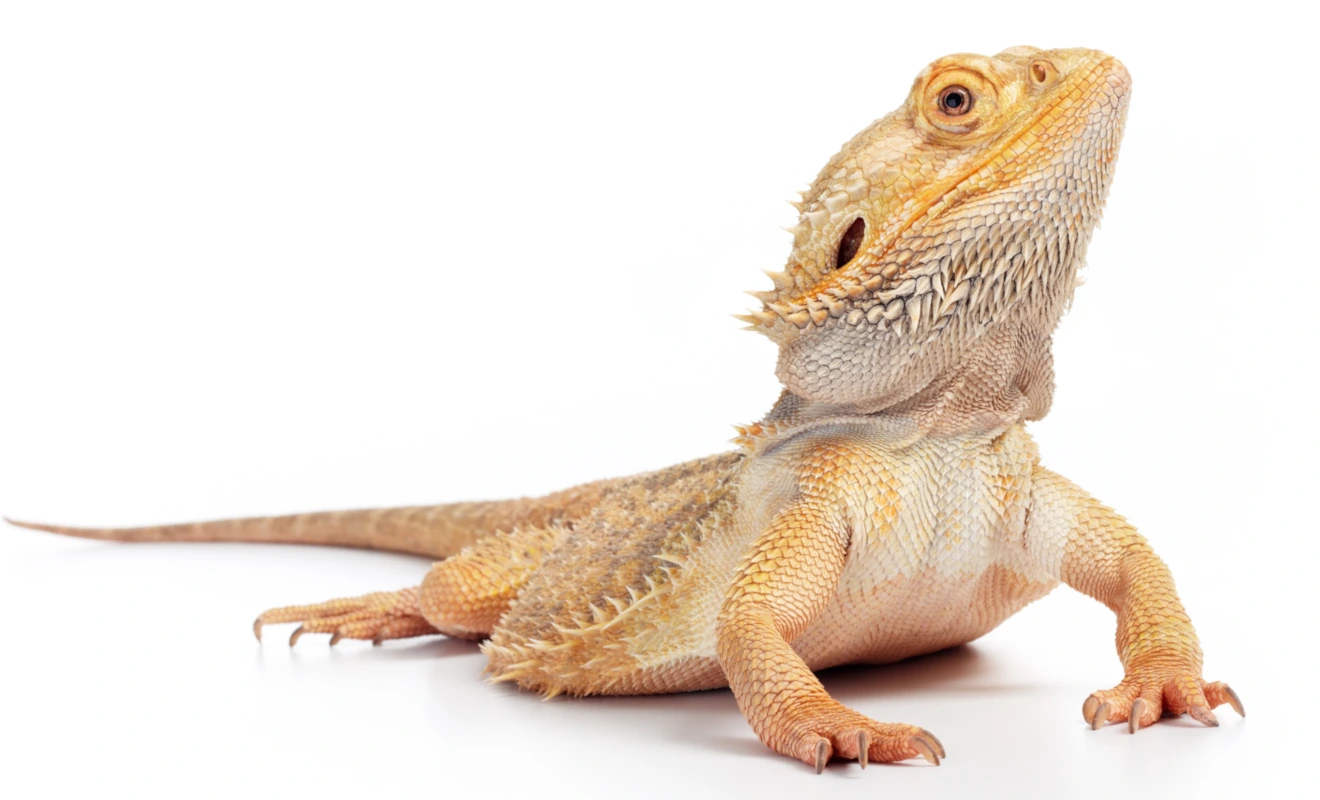
Bearded Dragon
🔤 Taxonomy
Pogona vitticeps is the currently accepted scientific name. In the hobby and in trade, the species is usually sold under the same name or under its common-name equivalents.
English common names used in the hobby:
- Bearded dragon
- Central bearded dragon
German common names used in the hobby:
- Bartagame
- Zentralbartagame
📌 Description
The Bearded Dragon ( Pogona vitticeps ) is one of the most popular lizards in the terrarium trade. Its name comes from the characteristic expandable throat pouch with spikes, which darkens under stress or dominant behavior and resembles a beard.
Adult specimens reach 45–60 cm in length. The coloration varies from gray-beige to orange and reddish, with many morphs existing in breeding practices. The body is flat, with well-developed limbs and spiny scales on the sides of the head and body.
Bearded Dragons are primarily ground-dwelling lizards, but they are good climbers and love to bask on elevated surfaces. In captivity, with proper care, they live on average 10–15 years, and sometimes even longer.
🌍 Distribution
The species originates from eastern and central Australia. It inhabits:
- Semi-arid areas
- Dry scrublands
- Sparse forests
- Sandy and rocky terrains
The climate in its natural range is characterized by:
- Very hot days
- Strong sunlight
- Low to moderate humidity
- Cool nights
The Bearded Dragon is a territorial species and lives alone in the wild. Keeping them together in one terrarium often leads to aggression and is not recommended.

🌡 Climate across the native range
Monthly climate normals from reviewed GBIF occurrence locations:
New South Wales — Australia
| Month | Min °C | Mean °C | Max °C | RH % |
|---|---|---|---|---|
| January | 19.5 | 26.4 | 33.1 | 37 |
| February | 19.1 | 25.6 | 32.1 | 40 |
| March | 16 | 22.3 | 28.5 | 45 |
| April | 12.5 | 18 | 23.8 | 53 |
| May | 9.4 | 14 | 19.1 | 65 |
| June | 7.1 | 11.1 | 15.9 | 73 |
| July | 6.4 | 10.6 | 15.5 | 70 |
| August | 7.2 | 12.1 | 17.4 | 61 |
| September | 9.5 | 15.2 | 21.1 | 55 |
| October | 12.1 | 18.5 | 24.9 | 46 |
| November | 15.2 | 21.8 | 28.3 | 42 |
| December | 17.5 | 24.3 | 30.8 | 38 |
South Australia — Australia
| Month | Min °C | Mean °C | Max °C | RH % |
|---|---|---|---|---|
| January | 18.2 | 24.5 | 31.4 | 45 |
| February | 18.2 | 24.1 | 30.8 | 46 |
| March | 15.4 | 21.1 | 27.4 | 51 |
| April | 12.6 | 17.5 | 23.3 | 57 |
| May | 9.5 | 13.6 | 18.6 | 68 |
| June | 7.3 | 10.8 | 15.2 | 75 |
| July | 6.5 | 10.1 | 14.4 | 75 |
| August | 7 | 10.9 | 15.5 | 71 |
| September | 9 | 13.7 | 19 | 64 |
| October | 11.4 | 16.9 | 22.9 | 55 |
| November | 14.2 | 20.1 | 26.5 | 49 |
| December | 16.2 | 22.4 | 28.8 | 46 |
Queensland — Australia
| Month | Min °C | Mean °C | Max °C | RH % |
|---|---|---|---|---|
| January | 24.1 | 29.9 | 35.7 | 40 |
| February | 22.9 | 28.4 | 33.9 | 45 |
| March | 20.4 | 26.1 | 31.8 | 43 |
| April | 16.1 | 21.8 | 27.6 | 45 |
| May | 11.5 | 16.6 | 22.2 | 56 |
| June | 8.5 | 13.1 | 18.5 | 65 |
| July | 7.3 | 12.4 | 18.3 | 60 |
| August | 8.7 | 14.7 | 21 | 48 |
| September | 12.8 | 19.2 | 25.7 | 40 |
| October | 16.6 | 23.2 | 29.6 | 36 |
| November | 19.9 | 26.1 | 32.2 | 38 |
| December | 22.4 | 28.5 | 34.5 | 37 |
Weather data by Open-Meteo.com · CC BY 4.0 · Monthly normals calculated by Herpeton Academy from daily archive values.
Location references use GBIF.org occurrence data where available; original occurrence records retain their source dataset licenses.
⚖️ Legal status
As checked against current official sources in April 2026, Pogona vitticeps was not found in the CITES Appendices and no specific EU wildlife trade Annex listing was found for this species.
The species is not relevant to the Bern Convention because it is not native to Europe. National and local rules on import, transport, sale, breeding, and animal welfare may still apply, so keep purchase records and proof of origin.
🤌 Husbandry
The Bearded Dragon is considered a relatively hardy species, but it requires a spacious and well-equipped terrarium.
Current recommendations indicate a minimum size 180 × 60 × 60 cm for an adult specimen. Smaller sizes limit movement and thermoregulation.
The terrarium should be:
- Front-opening
- Well-ventilated
- With a clearly defined warm and cool end
A suitable substrate is fine sand or sandy soil with a depth of at least 10 cm to allow for natural digging. Sick or injured animals should not be kept on loose substrate.
💡 Lighting
Bearded dragons are diurnal and require intense lighting.
It is necessary:
- Strong daylight (~6500K)
- High-quality UVB lighting
A T5 HO UVB lamp 10–12% is recommended, placed on the warm side of the terrarium. The UV index in the basking area should reach around 4–4.5. The lighting should operate for 12 hours a day. The UVB lamp should be replaced every 6–12 months.
Important: The UVB lamp and daylight are two separate sources.
For UV planning, treat this species as Ferguson Zone 4. Aim for about UVI 4-6 at the animal’s back or shell height in the basking zone, with a gradient down to shaded areas near zero UVI. This usually points to a strong 10-14% T5 UVB tube or a measured mercury vapor/metal halide system in a large enclosure; measure with a Solarmeter 6.5 when possible, because reflector, mesh, distance, and lamp age change the real exposure.
🌡 Heating and temperature
Bearded dragons need high temperatures in the basking area.
- Basking surface temperature: 40–46°C
- Cool zone: 21–29°C
- Heating is turned off at night
Halogen lamps with sufficient power are most suitable. The temperature should be measured with an infrared thermometer.
💧 Humidity and water
Bearded dragons prefer a relatively dry environment. Recommended humidity: 30–60%. Constant humidity above 60% can lead to health problems. Light misting 1–2 times a week is sufficient. The animal should have constant access to a shallow dish of fresh water; regular bathing is not necessary.
🌿 Enclosure and decoration
The decoration should include:
- A flat stone surface for basking
- Stable branches and roots
- Hiding spots
- Rocks and textured elements
🪳 Feeding
The bearded dragon is an omnivorous species.
Ratio according to age
- Hatchlings (0–6 months): 60–80% insects
- Juveniles: 50–60% insects
- Adults: 20–30% insects, the rest plant food
Suitable insects:
Crickets, dubia roaches, black soldier fly larvae, silkworms, grasshoppers. Insects should be well-fed (gut-loaded) before feeding.
Suitable vegetables:
Dandelion, arugula, kale, carrot tops, bok choy, alfalfa, zucchini.
Fruits should be avoided or given rarely due to high sugar content.
🧂 Supplements
Necessary:
- Calcium without D3
- Multivitamins with D3
Supplements are used according to the manufacturer’s instructions; calcium and UVB deficiency leads to metabolic bone disease.
🩺 Common problems
Most captive problems in bearded dragons come from weak UVB, poor diet, incorrect basking temperatures, dehydration, loose-substrate accidents, or chronic stress. Warning signs include soft jaw or limbs, tremors, swollen eyes, repeated constipation, weight loss, burns, and persistent refusal to eat.
If problems appear, first check UVB output, basking surface temperature, hydration, diet balance, and stool quality. If there is severe lethargy, repeated impaction, obvious deformity, injury, or ongoing weight loss, contact a reptile veterinarian.
📌 Conclusion
The bearded dragon is a calm and socially tolerant lizard towards humans, making it an excellent choice for experienced terrarium keepers. Successful care requires:
- A spacious terrarium
- Strong UVB lighting
- High temperature in the basking area
- Suitable dry microclimate
- Balanced omnivorous diet
With proper care, this species can live over a decade and be an active and healthy pet.