Furcifer lateralis
🔤 Taxonomy
Furcifer lateralis is the accepted scientific name for the Carpet chameleon covered here. Use this Latin name when comparing labels, origin documents, and close relatives, because trade names can overlap.
English common names used in the hobby:
- Carpet chameleon
German common names used in the hobby:
- Teppichchamäleon
📌 Description
Furcifer lateralis is a non-venomous lizard with care needs shaped by its natural habitat: sunlit shrubs, forest edges, gardens, grassland margins, and seasonally variable vegetation. Adults are usually around 17-25 cm total length, and a realistic captive lifespan is 3-5 years when housing, diet, and veterinary care are handled well.
This is not an impulse animal. The enclosure has to be planned around adult size, daily maintenance, heat and humidity measurement, and the keeper’s ability to notice stress before it turns into disease. Captive-bred animals from transparent sources are strongly preferable, especially for species that have a history of wild collection.
The most useful care mindset is to build choices into the enclosure. The animal should be able to warm up, cool down, hide, drink, feed, and move without being forced into constant exposure.
🌍 Distribution
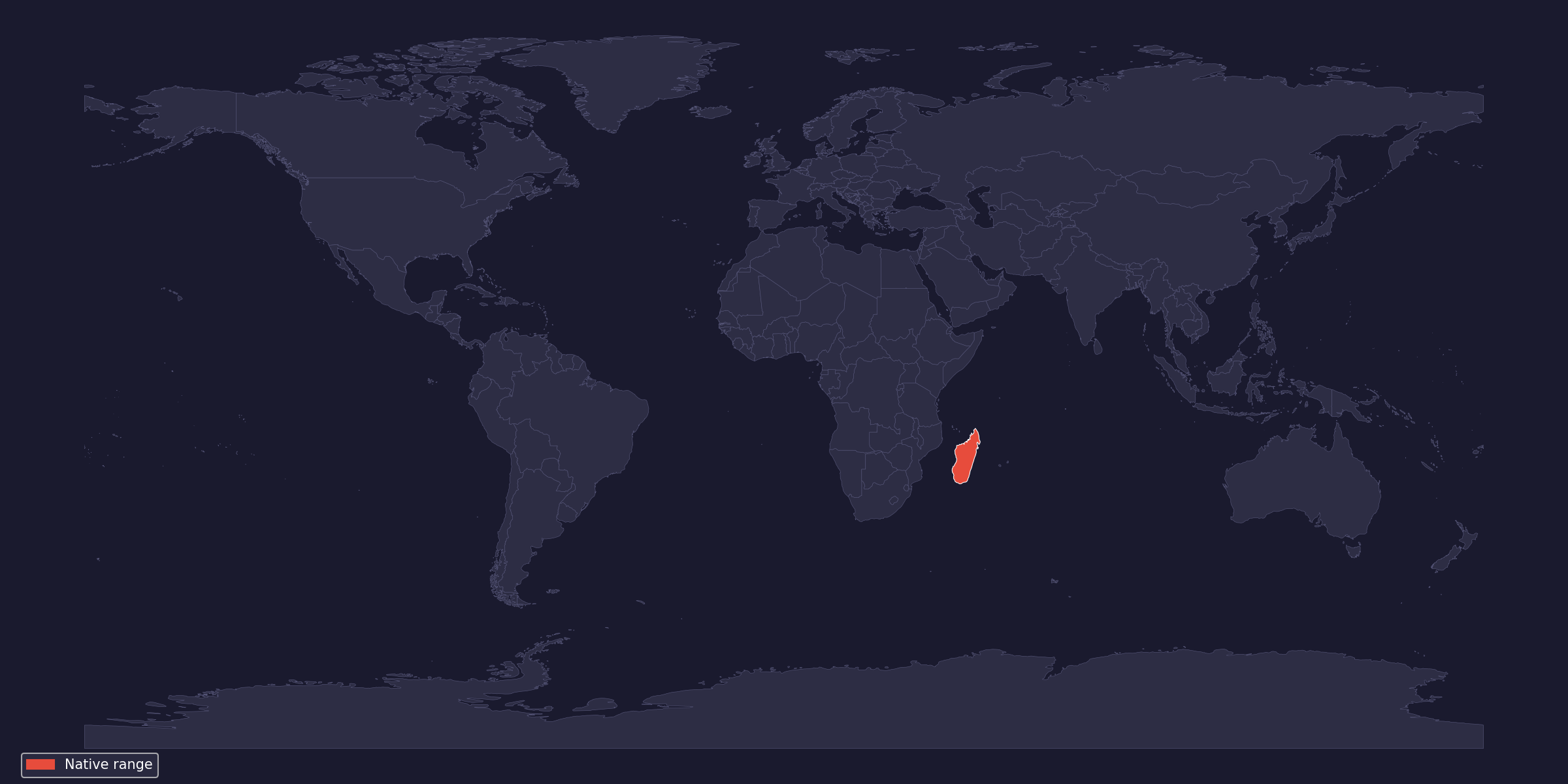
Furcifer lateralis is native to open, shrubby, and forest-edge habitats across much of Madagascar. In nature it is associated with sunlit shrubs, forest edges, gardens, grassland margins, and seasonally variable vegetation. That distribution should be read as a care clue rather than copied as one fixed number: the animal uses shade, cover, burrows, vegetation, water, season, and daily movement to choose suitable microclimates.
For captive care, the useful lessons are:
- secure retreats and visual cover
- a measured thermal gradient instead of one uniform temperature
- humidity that matches the species without stagnant wet air
- clean water and predictable hygiene
- enough usable space for normal movement
⚖️ Legal status
As checked against current CITES Appendices and Species+ references in May 2026, Furcifer lateralis is listed in CITES Appendix II and is normally treated under EU wildlife-trade rules as Annex B unless a stricter national rule applies. It is not relevant to the Bern Convention because it is not native to Europe. Keep invoices, breeder records, import/export paperwork where relevant, and proof of legal origin. National rules on ownership, registration, sale, breeding, transport, and dangerous-animal lists may still apply.
🤌 Husbandry
Plan for at least 45 x 45 x 90 cm for one adult, with dense planting and excellent ventilation. Smaller juvenile setups can be useful for monitoring feeding and shedding, but they must still include a warm area, a cool area, water, cover, and secure ventilation. Bare oversized enclosures often make new animals defensive or inactive; clutter and sight breaks make space usable.
Keep only compatible animals in the same system. Solitary reptiles should be housed alone. Social mammals still need stable groups, quarantine for newcomers, and enough feeding points and shelters to prevent bullying. Daily checks should include water, waste, locks, temperature, humidity, appetite, skin or shed condition, and behaviour.
Use digital thermometers and hygrometers rather than guessing. Record feeding, weight, sheds, cleaning, and veterinary issues. A simple log makes seasonal changes, gradual weight gain, and early illness much easier to interpret.
💡 Lighting
Provide a clear day-night rhythm. Diurnal reptiles need bright visible light and appropriate UVB; snakes and mammals still benefit from a predictable photoperiod, but they also need dark retreats and darkness at night. No visible night lights should shine into the enclosure.
For UVB-using reptiles, use a linear T5 lamp matched to the species, distance, mesh, and reflector. Provide shade and plant cover so the animal can leave the UV zone. Replace lamps on schedule and measure UVI when possible; powder supplements are not a replacement for correct light, heat, and diet.
🌡 Heating and temperature
Practical temperature targets: basking 28-31 °C, daytime ambient 22-26 °C, cool retreat 20-22 °C, night 16-20 °C. These values should create a gradient, not a single average. Measure basking surfaces with an infrared thermometer and ambient zones with digital probes.
Every heat source must be controlled by a thermostat or dimming controller where appropriate. Avoid heat rocks and unguarded bulbs. If the animal avoids the warm zone, gapes constantly, soaks all the time, refuses food, or stays hidden for days, verify the actual temperatures before changing diet or handling.
💧 Humidity and water
Target humidity and water management: 50-70% by day with higher night humidity and complete surface drying between mistings. Humidity should be paired with ventilation. Constantly wet, dirty air is not the same as healthy humidity, and chronic dryness is a common cause of dehydration and bad sheds.
Fresh water should always be available in the form the species actually uses. For arboreal lizards and chameleons, this often means misting, dripping, or rain-style droplets on leaves. For snakes and mammals, a clean bowl is basic, but substrate dryness and hygiene still matter.
🌿 Enclosure and decoration
The enclosure should be functional first and attractive second. Use secure hides, branches, cork, live or artificial plants, rough shedding surfaces, safe digging or climbing zones, and enough visual barriers that the animal can move without feeling exposed. Heavy-bodied species need furnishings that cannot collapse.
Substrate should support the humidity and behaviour of the species while staying clean. Avoid dusty bedding, sharp decor, sticky tape inside the enclosure, unstable rocks, and small loose items that could be swallowed. Doors, vents, cable ports, and lids must be escape-proof.
🪳 Feeding
Feed a varied, species-appropriate diet: small to medium gut-loaded insects such as crickets, roaches, flies, silkworms, and locusts. Young animals usually need smaller and more frequent meals; adults need body-condition-based feeding rather than food every time they appear interested. Overfeeding is as real a welfare problem as underfeeding.
Feeder insects should be gut-loaded and dusted according to the species and UVB plan. Snakes should be fed appropriately sized frozen-thawed prey whenever possible. Herbivorous-leaning mammals need fiber and low sugar. Remove uneaten food before it spoils and never leave live prey where it can injure the animal.
🩺 Common problems
Common problems include dehydration, reproductive exhaustion in females, overheating, retained shed, poor UVB exposure, and stress from visual contact. Warning signs include weight loss, repeated refusal to eat, weak grip or poor movement, wheezing, bubbles at the nostrils, swollen eyes, repeated bad sheds, mouth injury, burns, diarrhoea, or unusual aggression from an otherwise settled animal.
When something looks wrong, first verify the basics with instruments: warm zone, cool zone, night temperature, humidity, hydration, hide fit, diet, and recent stress. Serious weakness, injury, breathing signs, repeated regurgitation, neurological signs, or rapid decline need an experienced exotic-animal veterinarian.
📌 Conclusion
Furcifer lateralis can be kept responsibly when the keeper plans for the adult animal and treats legal origin, measured climate, suitable diet, and veterinary access as part of the setup. The best enclosure is not the most decorative one; it is the one that gives the animal safe choices every day.
📚 Sources and further reading
- GBIF species backbone entry for Furcifer lateralis
- CITES Appendices, checked May 2026
- Species+ CITES and EU wildlife-trade references, checked May 2026
- EU invasive alien species policy pages, checked May 2026 where relevant
- ReptiFiles and specialist husbandry references where available